Showing posts with label home. Show all posts

Monday, March 31, 2008

YCQ #9

It's the end of another month, and I haven't had anything to say. So guess what that means! It's that time again folks: It's the Yellow Card Question Show!

For today's theme song, we are going to borrow one from another show: Chibi Maruko Chan, aka 櫻桃小丸子, aka ماروكو الصغيرة, aka 마루코는 아홉살, etc. Choose your language and start the music playing: Japanese, German, Mandarin, Cantonese, Arabic, Korean. I'm sure there are Bahasa and Tagalog versions out there and perhaps some others, but I can't be bothered to find them at the moment. You'll just have to cope with these options.

So what now? What we've all been waiting for -- let's have a question! Do your happy dances for a moment while I spin the wheel, roll the die, shuffle the deck, and blow on the tea leaves.


Hmm. This question was meant for Chinese students who have three to five roommates in their dorm rooms. It doesn't quite make sense to ask it of myself, but then who said these questions had to make sense.

Well, the simple answer is that I would go crazy. I don't have much furniture in my room, but I don't have much floor space either. I have just my one bedroll on the floor, various items of furniture and boxes along the walls, and a section of bare floor that I like to be able to walk on. I don't like walking on strangers, or friends for that matter. I suppose that if my "roommates" included those sleeping in my living room, than I would perhaps go a little less crazy, but there's not much out there to sleep on either. This silly building doesn't even have places to put hammock hooks! With no bunk beds, no hammocks, and shortage of couches, I just don't think there is any way 6 more people could live here, unless they slept in shifts. That might work. Both my current roommate and I do tend to alternate hours awake. For example, I sometimes sleep 7 PM to 9 PM and 2 AM to 8 AM, and my roomie might sleep 9 PM to 1 AM and 6 AM to noon. But still, a general increase in the average level of insanity would be unavoidable.

Saturday, March 03, 2007

Home Again Home Again, Jiggity Jog

In the past four weeks, I have slept in eight cities, and ridden buses, metros, trains, a bullet train, a motorcycle, a rental car, a moto taxi, a few regular taxis, airplanes, and several cars of friends and family. And I walked a lot too. It was very good to see everyone, and it is good to be back.

Income Tax!
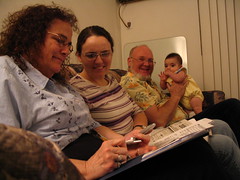
Dad and Nathanael

I celebrated Chinese New Year, Carnaval, and President's Day in Los Angeles with my family. In my family, whenever these three important holidays fall on the same weekend, rather than trying to dance half-naked in the street, lighting firecrackers and waving American flags, we just sit around filling out income tax forms and taking turns holding the baby.

Now I have returned to Jinhua, where they are hanging red paper lanterns and shooting off fireworks to celebrate my birthday. It's very thoughtful of them.

Friday, February 02, 2007

Change of Plans

I have decided to make an emergency run home during my one month winter break. I need to meet with the professors at next year's school options, get out of the country, and see my people. I need a hug and, most importantly, a burrito!

I hope the following isn't misunderstood, and doesn't offend. Much of it is generalizations that should perhaps be more carefully qualified. I have a corresponding list in progress of things I like about living in China, but I'm pretty sure I will have an easier time thinking of those things when I'm in California. (The grass is always greener.) You can expect to see that list in a month or so. What is more relevant at the moment is my list of things I don't like about living in China:

  • I have no peer group. I have only weak social groups. I have no roommates. I miss human contact.
  • I have had very little time to practice Chinese. Relatively little context to speak, and for much of the semester I was too busy to study.
  • I also managed to not do any other things I had hoped to explore here, like classical painting, martial arts, ancient Buddhism or Daoism.
  • There are very few natural areas to visit. The roads are paved, the fields are plowed under (though mostly by hand), the lakes are artificial, and the rivers are polluted.
  • The historical sites are reconstructions, with almost nothing remaining more than 20 years old.
  • The assumption that dating Chinese women is a high priority for me, even a major reason for coming here. I can understand why this stereotype exists, since there are a lot of single men who come here as teachers or on business, and many of them do have Chinese girlfriends. And some of them, even one I know, have dislikable attitudes towards Chinese women. The effect is that I, as a representative white male American, am assumed to have similar intentions. The combination of that and being an exotic species makes me the object of some somewhat annoying attention, and some dislike.
  • The media control is real, with pretty limited variety on TV. The news seems to be even less trustworthy than Fox or BBC Science. (And much less sensational/interesting).
  • The nationalism and patriotism turn up in surprising places. It's sometimes just quaint, but other times like fingernails on a chalkboard. As far as I can tell, there is no stigma against nationalism. (Contrast this to Mexico City, where the relevant question being discussed was "Is nationalism ever a good thing?" if I remember correctly.)
  • People assume that I like Bush and his policies, and that I'm nationalistic too.
  • The Great Firewall blocks a lot of content: wikipedia, many blog and website hosts, many news sources, and many random pages. And it dramatically slows down international traffic too. It makes it harder to connect with friends and family in the States, read different perspectives on the news, and read academic articles. The internet connection is pretty poor when school is in session, and really bad in the evening.
I'm hoping I will be able to make some changes on some of these points next semester, and getting out of the country will help refresh my memory of what I do like about being here.

Friday, December 15, 2006

October Podcast

Inspired by my favorite podcasters Mano Lopez and the Homemade Show, and by the shortage of music here that I like, I decided I would start doing a podcast. I figured I could do one once a month or every other month, and I put together most of this playlist one week in October. After a short delay, I now present to you my first podcast. You can expect January's podcast in mid-March.

October: 故乡何处是?

The Chinese question in the title means "Where is my hometown?" and it's a quote from Li Qingzhao, a poet who moved from Shangdong province to Zhejiang in the 1100s when the north was engulfed in war.

Playlist:
Solo - Theo Torres
Happy Birthday - ZJNU Student Choir
水云间 (Water Cloud Space (?)) - 童孔 (Tong Kong)
呼吸 (Breathing) - 常静 (Chang Jing)
La Vida es un Carnaval - Issac Delgado
Y Soy Llanero - Grupo Cimarrón
Chicharra - Marta Gomez
Damaquiel - Hector Buitrago et al.
Amortiguador - Andrea Echeverri
Acochado Todo - Almir Rouche
Mindjer Dôce Mel - Eneida Marta
The Easy Way - That Mad Ahab
Stay in New England - Mimi LaValley
Leaves that are Green - Simon and Garfunkel

play

Saturday, November 25, 2006

Free Hugs

This video makes me happy.
With the low resolution it looks a lot like Patiunky, and I can totally imagine him doing something like this, even if it is somewhat at odds with his current YouTube persona.

Apparently the Free Hugs Campaign has quickly spread all over the world, though it is having difficulty some places. In China, for example, hugging counts as inappropriate public display of affection, and it's considered a foreign custom, too. Oh well.

Saturday, October 28, 2006

故鄉何處是?

有个学生在她的日志问为什么外国人那么常常那么遥远旅行。
我在乌兹别克看我哥哥的时候,哥哥的朋友表达了差不多一样的意思。现在他也去过别的国家,但是那时侯他也觉得常常遥远旅行很奇怪。我妈妈告诉他,你认识的外国人只是喜欢旅行的外国人。很多的外国人不常去远。
但是还有真的分别。中国也在改变呢,可是家乡概念在这儿还很重要。上个星期学生社会谈论外国文化。那儿有三个外国人:一个索马里的本科学生,一个也门的留学生,和我。对每个外国人问了家乡怎么样,我们差不多不能回答。索马里的人在沙特阿拉伯出生,没看过索马里。也门的人住在英国,不常去也门。我也告诉他们,我没有真的家乡。这样的事对中国人很难懂。人结婚了,常常跟丈夫的父母一起住,如果不跟他们一起住,他们应该在不远的地方。大学生不跟父母一起住,有的学生回家得座五六个小时的车,但是放了寒假,暑假都回家,放了中秋节的假,大部分也回家。大部分没从浙江省出去过。外国人来中国过一年多,不看他们的家,对中国学生的看法真奇怪。
墨西哥人真这样。在墨西哥,大学生回家每天或者每个星期,每天座一个多小时的车或者每个星期座五六个小时的车不奇怪。但是男人常常过半年不看他们家,因为需要去非常远的地方找工作。
国家文化都有自己的习惯,有一点不同,但是心里差不多。虽然我没有家乡,我认识的人都不在叁塔巴巴拉或者哥伦比亚,但是我想我认识的人,我还想我住过的地方。什么国家的大学生,留学生,外教,季节工人都想家。

There was a student who asked in her free-writing journal why foreigners so often travel so far.

When I was in Uzkekistan visiting my older brother, his friend expressed a similar thought. Now that friend has also traveled to other countries, but at that time he also thought frequent distant travels are pretty strange. My mother told him, "The foreigners you know are only those who do like to travel." There are many foreigners who rarely travel far.

But there is also a real difference. China is also changing, but the concept of hometown is still very important here. Last week a student club was discussing foreign cultures. There were three foreigners present: a Somali regularly enrolled student, a Yemeni exchange student, and me. They asked each of us foreigners what our hometown was like, and we were all pretty much unable to answer. The Somali was actually born in Saudi Arabia, and has never seen Somalia. The Yemeni lives in England and only rarely goes to Yemen. I also told them I don't have a hometown. This sort of thing is hard for a Chinese person to understand. When a couple marries, the often go to live together with the husbands parents, and if they don't live with them, they shouldn't live very far away. University students don't live with their parents, and some of them must take a bus for five or six hours to return home, but every summer and winter holiday they all return home, and during the autumn one-week holiday, the majority also return home. The majority have also never left Zhejiang province. For foreigners to come to China for a year or more and not see their families, to the Chinese way of thinking seems quite strange.

Mexicans are really like that too. In Mexico, university students return home every day or every week. Riding a bus for over an hour each way every day or five or six hours every weekend is not unusual. However men often pass half the year without seeing their families, because they must travel extremely far to look for work.

The cultures of different cultures each have their own customs, which are a little different, but their hearts are much alike. Although I don't have a hometown, and none of the people I know live in Santa Barbara or Colombia, I still the miss the places I have lived, in addition to the people I have known. The college students of every country, exchange students, foreign teachers, and migrant workers all get homesick.